The Bread Baking Industry
Bread is an essential resource eaten throughout the world. Bread is versatile and can be an alternative for rice and other grains. The practicality producing bread is that it is packed with carbohydrates, minerals and nutrients. Some cultures of the world consider bread as one of their staple food and are an important necessity.
 |
| Gardenia Bakeries Products |
Gardenia Bakeries was established by Horatio Sye Slocumm in 1969. The company first opened its doors to the public in 1978 in Singapore and made rapid progress around the early 1980's. By 1986, Gardenia Bakeries had extended its market into East Malaysia (Gardenia Bakeries, 2013). Now Gardenia is well known as a local brand that provides top quality bread and is one of the leading bread producers in Malaysia. A vast majority of Malaysians now refer to "Gardenia" as a local slang for bread. Besides producing white bread, Gardenia Bakeries offer a wide range of other products such as Toast'em, Breakthru and Delicia. Such products are produced to cater different tastes of consumers in the market.
With a wide range of products to produce, how does Gardenia Bakeries keep up with the demands of the public? Also, how will the company fare against other competitors such as The Italian Baker; well known for its Massimo range. Customers will have to consider price, substitutes and availability of the products before making the purchase. Despite the number of customers who are willing to pay and can afford, would there be any limit to where the company can supply its products to customers? Finally, would there be any efforts or interventions by the government that affects the production of the company?
Competition and Consumer Demands

To begin, we assume that Gardenia is part of a monopolistic competition in Malaysia. Here, there would be several firms that are in the same industry producing different types of products. Gardenia Bakeries will have to compete with the likes of other firms; for instance The Italian Baker and High 5. Each of these firms produces a wide range of bakery products including white and wholemeal bread. Bread is also assumed to be an alternative for rice, as rice is considered a staple for most Asian countries (National Geographic Education, no date). Thus, the demand for bread is fairly elastic as consumers have a wide range of bread to choose from. A change in taste and preference may impact the quantity of bread provided by Gardenia Bakeries.
To observe this, an interview with Don Yong; chairman of the Malaysian Institute of Banking, suggests that more and more people are switching from white bread to wholemeal bread (The Malaysian Times, 2012).
The Law of Demand states that, the higher the price of a good, the smaller the quantity demanded; Ceteris Paribus. This will cause a rightward shift in the demand curve. Since the demand of bread is quite elastic, a small increment in price of white bread may have a drastic change in quantity demanded. As a result, consumers may switch to wholemeal bread or decide not to buy at all. Here, a rise in demand for wholemeal bread will cause a rightward shift in the demand curve forming a new equilibrium in the supply-demand graph.

Supply Curves and Government Intervention
The Law of Supply states that quantity of goods supplied will increase when the price of the good increases. This is done to maximize the profits that can be obtained from the sales. Factors that can affect the supply curve of producing bread are prices of factors of production. Producing bread mainly consumes flour and sugar.
Prices of both sugar and flour are expected to rise due to peaks in global petrol prices (The Strait Times, 2013). Recently, the Malaysian Government was urged to reduce the sugar subsidy due to the increment of diabetics in the country (The Star Online, 2013). As a result, cost of production would increase for Gardenia Bakeries. Expected price hikes will have an effect on the supply curve. Both of the factors may cause the supply curve to shift leftwards. Gardenia Bakeries may have to reduce the quantity of bread supplied in order to cut down costs.
 |
| Effects of Subsidies on Quantity of Bread Produced |
Due the rise in factors of production in the industry, the Malaysian Government is planning to introduce subsidies, price floors and price ceilings by 2015 (Channel News Asia, 2013). The implication of such government intervention may lead to problems such as market failures. When supply does not meet the demands of consumers, underproduction or overproduction arises where the Marginal Social Cost is not equal to the Marginal Social Benefit. This is a form of market failure and results in a deadweight loss and the society is at loss.
Price ceilings or price caps imposed by the government are below the equilibrium, it may lead to shortages in flour and sugar supplies for both consumers and firms. Price ceilings of sugar prices are intended to prevent grocers from overcharging sugar to customers. A reason for shortages is that firms are unwilling to sell sugar or flour at the low price as maximum profits could not be attained. To top it off, some suppliers may sell sugar at a price higher than the price ceiling; this is called a black market. These economic transactions take place illegally to meet demands of the public. As an effect, Gardenia Bakeries may have to again reduce the quantity bread supplied of as demands for sugar and flour supplies cannot be made. As a side note, the price ceiling will not have a dire impact to the economy if it were to be above the equilibrium. The video below explains further the effects of price floors and who benefits from the government intervention.
Short-Run Implications
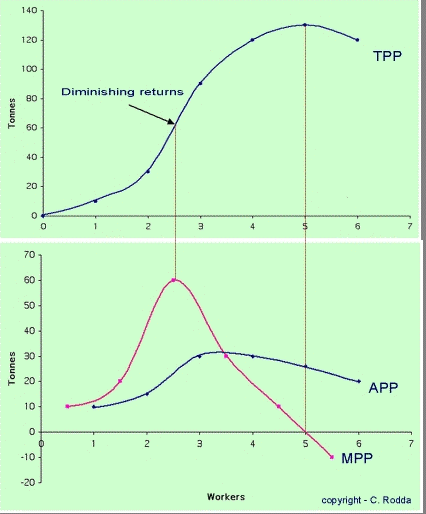
Gardenia Bakeries has only one known factory for bread production. In a short-run, Gardenia Bakeries has to equip and compute the necessary fixed and variable costs. This in turn will determine the output of the firm as a combination of inputs may give the most profit. But, there will be an instance that increasing one unit of factors of production with a fixed unit of another production factor may cause the output of the firm to be lesser than previous outputs (Paul. M. J., no date). This is explained by the Law of Diminishing returns. In the short-run, most factors of production are variable and at least one variable is fixed.
In this case, Gardenia Bakeries has only one plant along with machines; which is the Total Fixed Cost (TFC) and cost of labour and ingredients for baking which are Total Variable Costs (TVC). As production increases, more units of variable factors are used. This in turn will cause the Marginal Cost (MC) to be reduced. If more output is produced, the Law of Diminishing Returns will play its role. This occurs when the MC increases when a unit on output is produced. The intersection between the MC graph and the Average Fixed Cost (AFC) graph will indicate the optimal output by the firm; this is where the MC is the least before MC starts rising.
References:
1. The Malaysian Times (2012), Mind Your Bread, The Star [online] 23 April. Available from: http://www.themalaysiantimes.com.my/mind-your-bread/ [Accessed 21 October 2013]
2. The Straits Times (2013), Malaysia May Raise Sugar, Flour Prices, The Straits Times [online] 7 October. Available from: http://www.straitstimes.com/the-big-story/asia-report/malaysia/story/malaysia-may-raise-sugar-flour-prices-20131007
3. Channel News Asia (2013), Malaysia May Implement GST (Goods and Services Tax) by 2015, Bernama [online] 22 October. Available from: http://www.channelnewsasia.com/news/asiapacific/malaysia-may-implement/857372.html
4. The Star Online (2013), Dr. Subra: Sugar Subsidy Should Be Cut to Curb Diabetes, Bernama [online] 22 September. Available from: http://www.thestar.com.my/News/Nation/2013/09/22/Dr-Subra-Sugar-subsidy-should-be-cut-to-curb-diabetes.aspx
5. Paul, M.J. (no date) Glossary of Political Economy Terms. Available from: http://www.auburn.edu/~johnspm/gloss/diminishing_returns_law_of [Accessed 24 October 2013].
6. National Geographic Education (no date) Food Staple. Available from: http://education.nationalgeographic.com/education/encyclopedia/food-staple/?ar_a=1 [Accessed 24 October 2013]
7. McGlasson, M.J. (2011) Episode 15: Price Floors and Price Ceilings. Youtube [video]. 14 January. Available from: http://www.youtube.com/watch?v=XgBPAucs-W4
8. Gardenia Bakeries (2013), Brief History. Available from: http://www.gardenia.com.my/aboutus.html#p1 [Accessed 25 October 2013]
8. Gardenia Bakeries (2013), Brief History. Available from: http://www.gardenia.com.my/aboutus.html#p1 [Accessed 25 October 2013]
